Cover art for The SpaceBapepe Guide to the Mostly Unknown Universe
LoreCraft story

The SpaceBapepe Guide to the Mostly Unknown Universe

Duct Tape, Bananas, and the Quest for Galactic Snacks

Three optimists from Uranus follow a star map out of a broken vending machine, in a rocket that used to be a water tower. They cure a black hole of the hiccups, negotiate a peace treaty with a six-storey chicken, and are home in time for feeding.

15 scenes · 3 characters

The Vending Machine Revelation
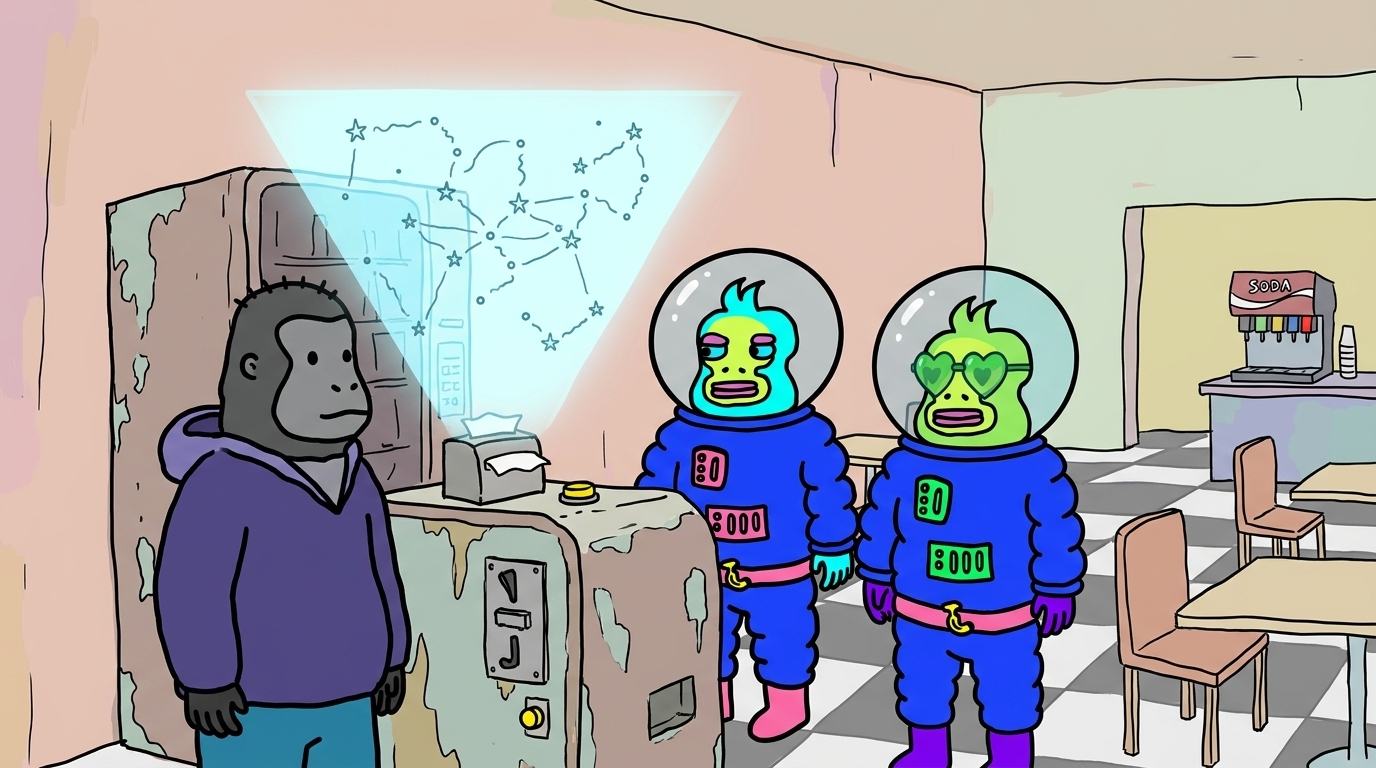
Interior of a snack bar. Three characters stand around an old vending machine: the grey ape in the purple hoodie on the left, and two crew in puffy blue spacesuits with round clear fishbowl helmets. A pale blue holographic star map floats in the air above the machine.
The Uranus Snack Bar, lower concourse

The Vending Machine Revelation

It was supposed to be a bag of moon-chips.

Hodl had put the coin in himself. He remembered doing it, because he remembered the machine making the noise it always made — the long unhappy grind, like a robot clearing its throat — and he remembered thinking, as he always did, that somebody really ought to fix that.

The coil turned. The bag moved forward. The bag stopped.

"It's stuck," said Teebs, from somewhere behind his left shoulder.

"It is not stuck," said Hodl, who could see perfectly well that it was stuck. "It is thinking."

Degen arrived at a full run, having heard the words *vending* and *stuck* from three tables away, and hit the machine with the flat of one gloved hand in the manner of someone who had solved many problems this way and would go on solving them this way regardless of results.

The machine did not release the chips.

The machine released a map.

It came out of the coin slot in a thin sheet of pale blue light, unfolded itself in the air above the napkin dispenser, and kept unfolding — past the ceiling tiles, past the flickering sign for the soda fountain, out into a slow-turning diagram of stars that none of them recognised and one of them, at least, should have.

For eleven seconds nobody said anything.

"Is that," said Teebs eventually, "where we live?"

It was. There was Uranus, small and pale and slightly off-centre, exactly where it was supposed to be. And there, spiralling away from it in a long lazy curve of little marked points, was everywhere else. Dozens of them. Hundreds. Each one labelled in a script that squirmed when looked at directly.

Degen's face had gone the particular shade of green it went before he said something expensive.

"We should go," he said.

"We have no ship," said Hodl.

"We have a *mostly* ship."

"We have a shed."

"We have a shed," Degen agreed, "with a *nose cone*."

Hodl looked at the map for a long moment. Somewhere behind him the machine gave one last grind and dropped the bag of moon-chips into the tray, four minutes too late to matter.

"Fine," he said, and picked them up. "But I'm bringing snacks."

The Uranus Exploration Club was founded that afternoon, between the soda fountain and the napkin dispenser, by three people and a vending machine that has never been asked to explain itself.
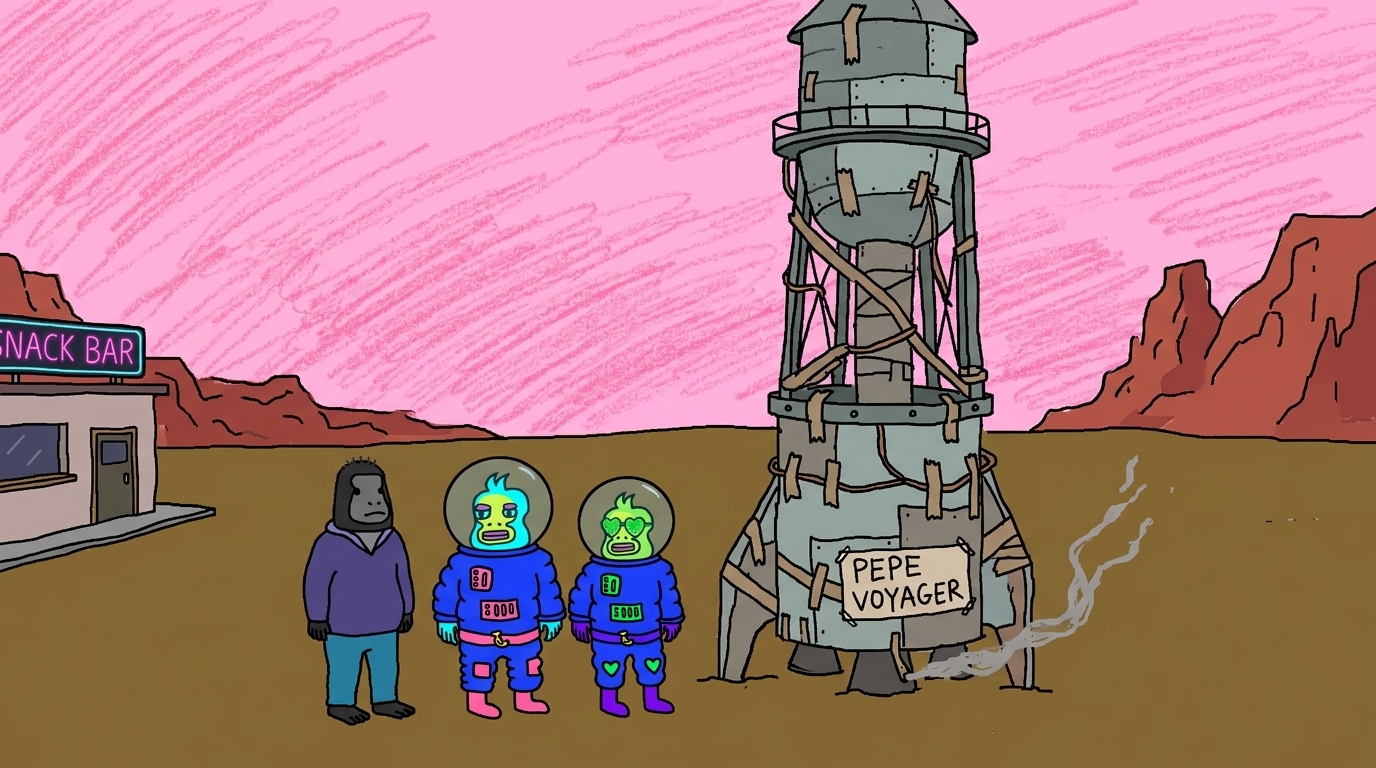
Launch of the Pepe Voyager
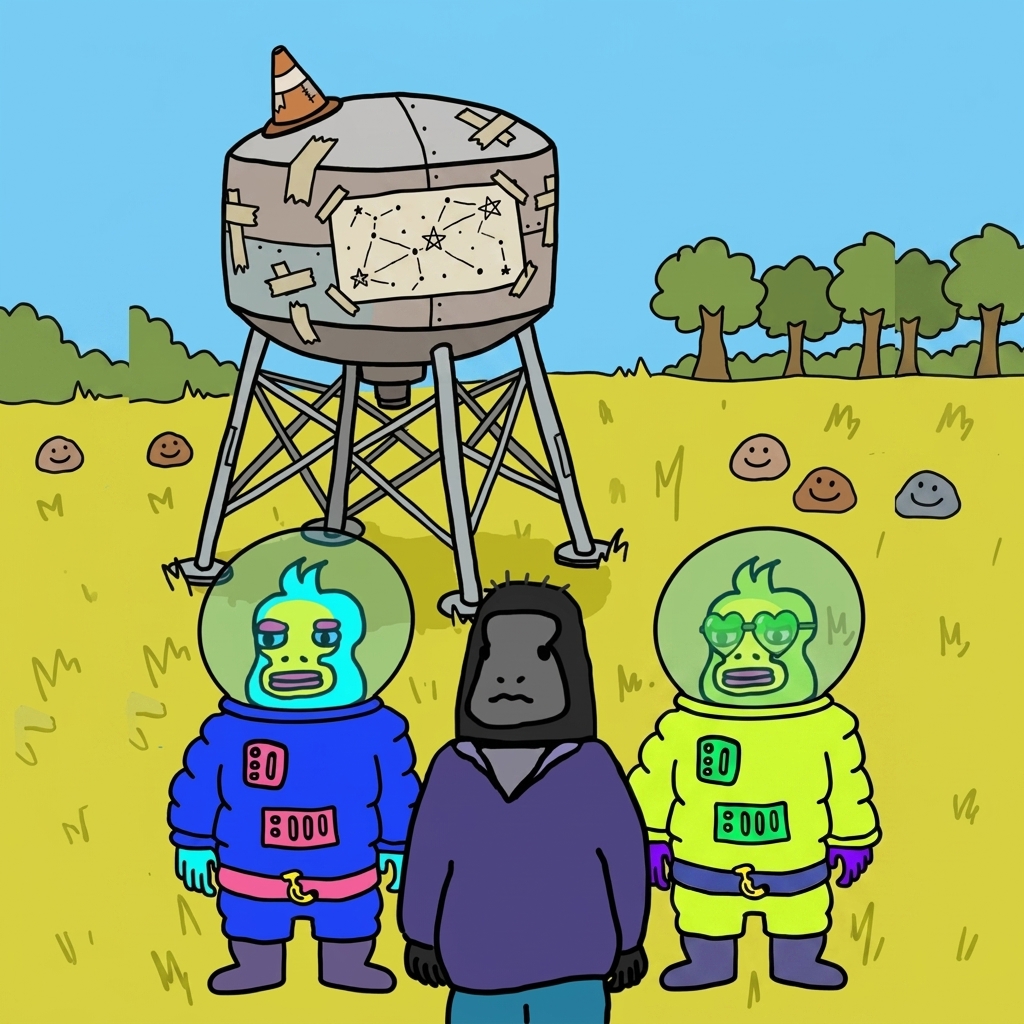
Exterior, dawn. The crew: a grey ape in a purple hoodie, and two characters in puffy electric blue spacesuits with round clear fishbowl helmets, one with a teal flame of hair and pink suit patches, one with green heart-shaped sunglasses and green suit patches. They stand at the foot of a tall patched grey rocket held together with visible tape, on an open field. Pink morning sky.
The launch field behind the snack bar

Launch of the Pepe Voyager

The Pepe Voyager was a masterpiece of mostly-functional engineering.

It had been a water tower. Before that it had been part of a bridge. The nose cone was genuine, salvaged, and slightly the wrong size, which Degen had solved with a quantity of tape that he described as "structural" and Hodl described as "visible from orbit."

It was, in fairness, beautiful. The morning light came up pink over the ridge and hit all four hundred feet of patched grey hull at once, and for a moment even Hodl had to admit it looked like a rocket rather than a rumour of one.

"Pre-flight," said Teebs, holding the manual.

"Pre-flight!" Degen agreed, holding nothing.

"Hull integrity."

"Great."

"Fuel."

"Some."

Teebs turned a page. "It wants a number."

"Put *some*."

Inside, the cockpit smelled of hot metal and orange soda. Three seats had been bolted in at slightly different heights, so that Hodl sat lowest and looked out at the underside of the console, which he found he preferred. Above him the ignition panel offered forty-one buttons, of which nine were labelled and two were labelled correctly.

"Which one starts the engine?" said Hodl.

"The green one!"

Teebs looked up from the manual with the mild, faraway expression that meant she had found something. "That's the emergency banana launcher."

There was a pause.

"Close enough," said Degen, and pressed it.

What happened next was, by universal later agreement, technically a launch. A banana left the ship at a speed no banana has any business achieving. The recoil — and this is the part the physicists still argue about — went the other way, into the ground, into the shed, and finally into the great patient bulk of the Pepe Voyager, which shuddered once, thought about it, and rose.

It rose slowly. It rose crookedly. It rose *anyway*, trailing tape and a thin ribbon of smoke, past the ridge, past the pink morning, past the last blinking sign of the snack bar concourse and out into the dark where the little marked points were waiting.

Hodl, pinned to his seat and looking at the underside of the console, said the only thing that seemed appropriate.

"Snacks are in the back."

The Hiccuping Void
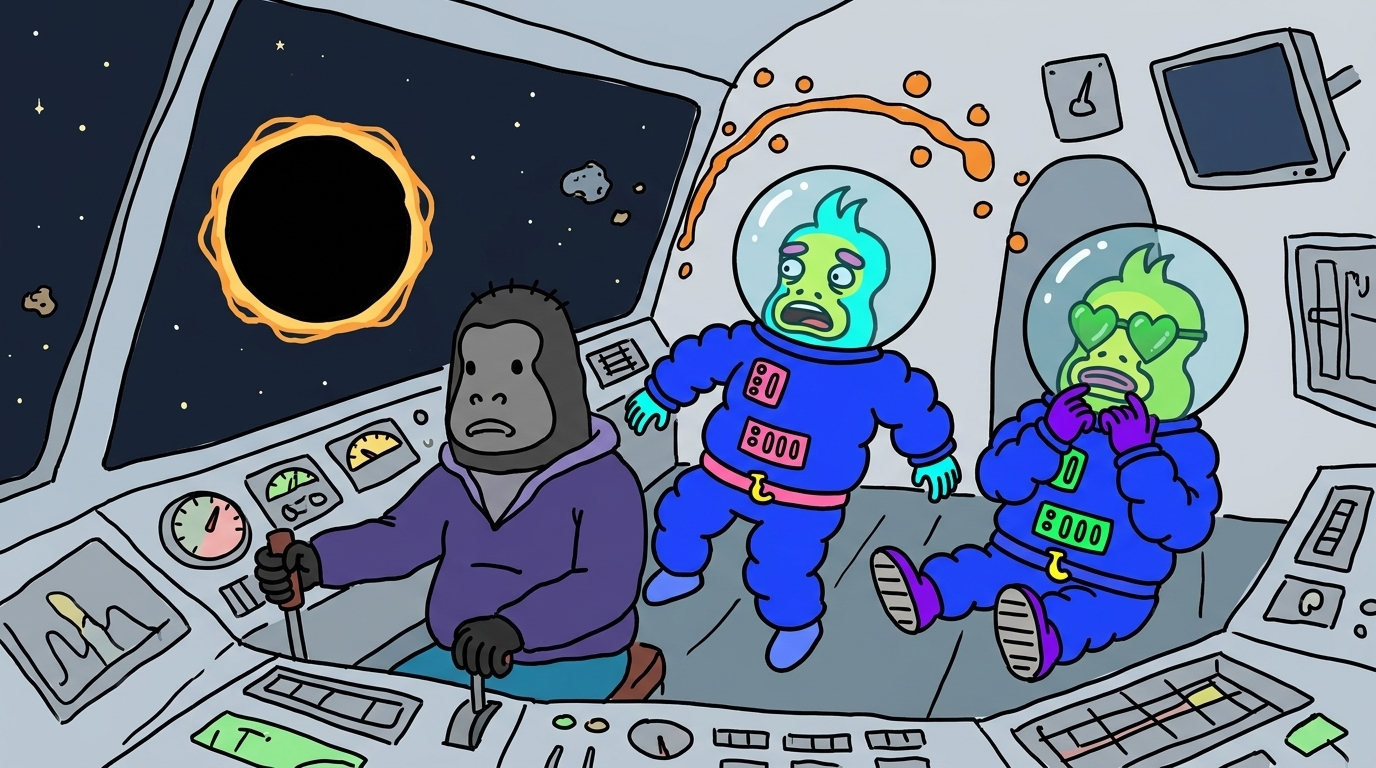
Interior of a small cockpit tumbling backwards. The crew: a grey ape in a purple hoodie, and two characters in puffy electric blue spacesuits with round clear fishbowl helmets, one with a teal flame of hair and pink suit patches, one with green heart-shaped sunglasses and green suit patches. Through the forward window a round black hole ringed with wobbling light. An arc of orange soda floats through the air.
Open space, three light years out

The Hiccuping Void

The first stop on the map was a black hole, and the black hole had the hiccups.

They noticed at four hundred thousand kilometres, which was closer than anyone had planned to notice anything. The Voyager was drifting in nicely, all instruments agreeing for once, when the dark ahead of them went *hic* — a small polite sound, felt rather than heard — and the ship went backwards three light years.

It took eleven hours to get back.

*Hic.*

Three light years.

"Right," said Hodl, on the fourth return, in the flat voice of a man who had now spent most of a week travelling the same corridor. "Ideas."

"Scare it," said Degen instantly.

"Scare a black hole."

"Everyone gets scared."

"With what?"

Degen considered the resources available to him and produced, from a compartment that Hodl had not previously known existed, a paper bag.

They tried the paper bag. The bag was inflated, held up to the forward window, and struck with considerable force. The resulting bang was extremely satisfying inside the cockpit and, being in a vacuum, entirely unheard outside it.

*Hic.*

Three light years.

On the seventh return, Teebs — who had been quiet for some time, and who had drifted to the back window with her chin in her hands — said, "It's not doing it on purpose."

"It's a black hole," said Degen. "It doesn't do anything on purpose."

"No, but." She turned round. Behind the heart-shaped lenses her eyes had gone soft and certain in a way the crew had learned, over four days and roughly ninety light years, to take seriously. "It's *every eleven hours*. It's regular. That's not a black hole having a bad time. That's a black hole with the hiccups. And you know what fixes hiccups."

"Being frightened," said Degen.

"Drinking water upside down," said Teebs.

Hodl looked at her for a long moment.

"We don't have any water," he said.

"We have orange soda."

"We have *some* orange soda."

The manoeuvre that followed is not, and will never be, in any manual. It involved the entire remaining supply of orange soda, the emergency banana launcher, and the Pepe Voyager rotating one hundred and eighty degrees on an axis it was not built to rotate on, while three people held on to whatever they could reach and Degen shouted encouragement at a gravitational singularity.

The soda went out in a long orange arc, turning slowly, catching the light.

And the dark ahead of them stopped.

Eleven hours later, nothing happened. Then eleven more.

"Huh," said Degen, sounding personally offended by it. "It worked."

Teebs had already gone back to the window, and was waving.

The Monster of Moon 7
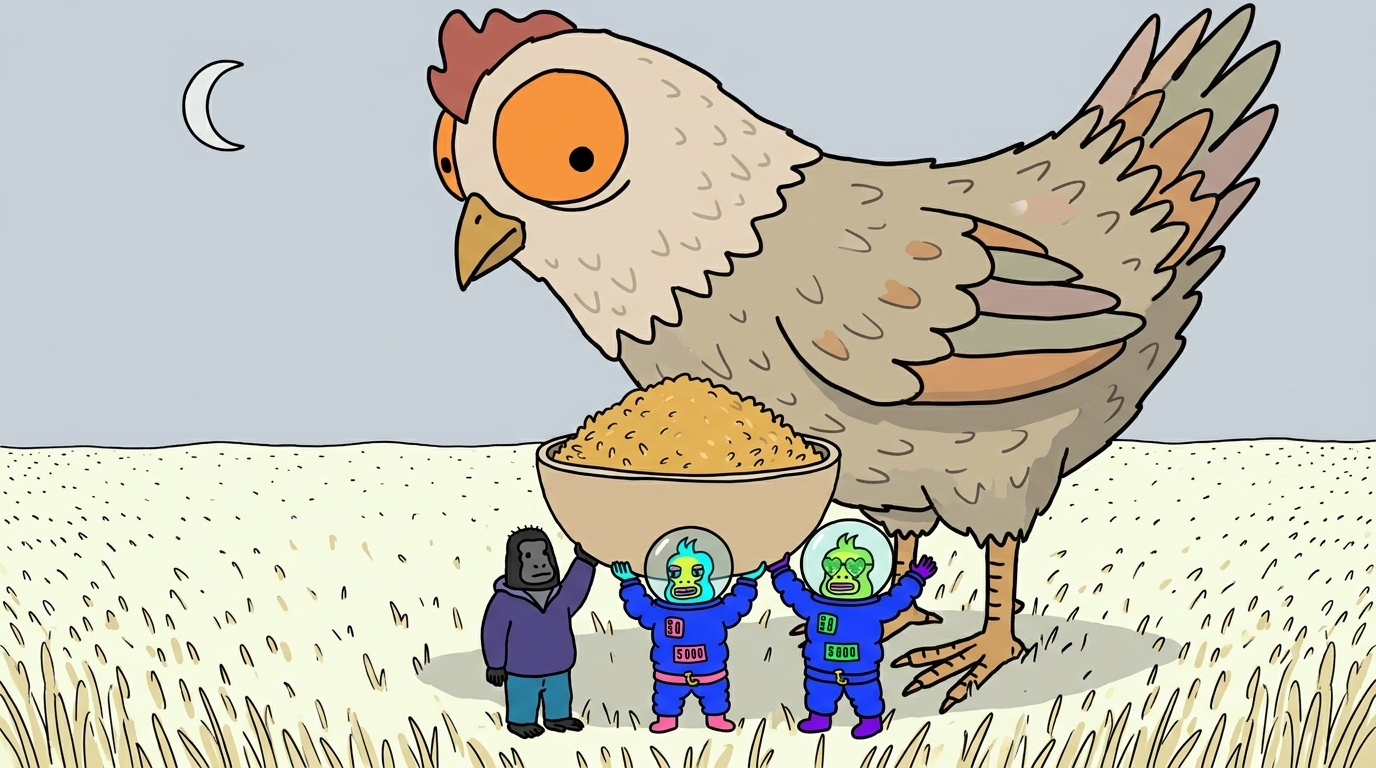
Exterior on a pale moon covered in grain. The crew: a grey ape in a purple hoodie, and two characters in puffy electric blue spacesuits with round clear fishbowl helmets, one with a teal flame of hair and pink suit patches, one with green heart-shaped sunglasses and green suit patches. They stand small at the feet of an enormous six-storey-tall chicken, holding up a huge bowl of grain between them.
Moon 7, the grain plains

The Monster of Moon 7

Every map has one point marked differently, and on this map it was Moon 7, where the squirming script drew itself larger and darker than anywhere else and resolved, when stared at, into a single word: **DEVOURER**.

They talked about it for two days. Degen was for going. Hodl was for not going. Teebs pointed out that the map had been right about literally everything so far, including the soda, and that settled it in the way that Teebs settled things, which was quietly and without anybody noticing they'd been argued with.

They came down through a thin grey sky onto a plain of pale grain that went to the horizon in every direction, moving in long slow waves though there was no wind.

The Devourer of Worlds was standing in the middle of it.

It was six storeys tall. It was, without any question or ambiguity whatsoever, a chicken.

Nobody said anything for a while.

"That's a chicken," said Degen.

"That's a chicken," Hodl agreed.

The chicken regarded them with one enormous flat orange eye, tilted its head through ninety degrees to regard them with the other, and made a sound like a barn falling down a hill.

What became clear over the following hours — and it took hours, because the negotiating positions had to be established through a combination of gesture, shouting, and one increasingly desperate mime performed by Degen on the roof of the ship — was this. The chicken was not devouring worlds. The chicken was eating the grain. The chicken had *always* been eating the grain, which grew back, which was the entire arrangement. Somebody, somewhere, at some point, had seen a six-storey chicken from a distance and drawn a conclusion, and the conclusion had gone into the map, and the map had gone into a vending machine, and here they all were.

The treaty took the rest of the afternoon.

Its terms were simple. The crew of the Pepe Voyager would return, at intervals, with grain — a great deal of grain, gathered from the plain itself, and presented in a bowl of appropriate size, which took all three of them and most of the cargo netting to carry. In exchange the Devourer of Worlds agreed, with what Hodl chose to interpret as good grace, not to peck the ship's hull.

This last clause was Teebs's idea. Hodl had not thought of it. Hodl had, in fact, been standing directly underneath the beak at the time, thinking about something else entirely.

"You're welcome," she said, later, on the way up.

"I didn't say anything."

"You were going to."

He was. He didn't. Below them the grain closed over the great pale shape of it, and Moon 7 turned slowly away, and Degen — who had said almost nothing for an hour, which was unprecedented — leaned back in his seat and announced to no one in particular that he was going to get a tattoo of a chicken.

Home Before Feeding Time
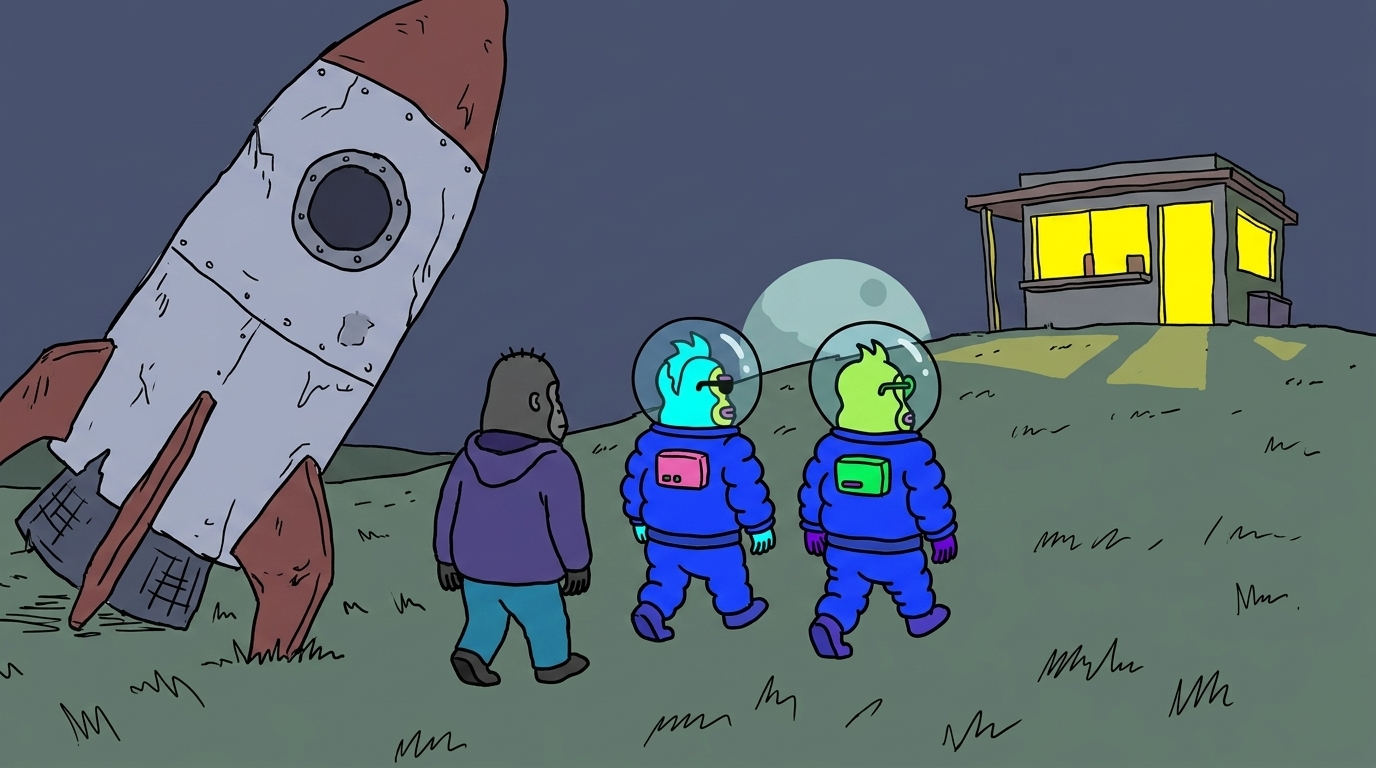
Exterior at dusk. The crew: a grey ape in a purple hoodie, and two characters in puffy electric blue spacesuits with round clear fishbowl helmets, one with a teal flame of hair and pink suit patches, one with green heart-shaped sunglasses and green suit patches. Seen from behind, walking away from a battered rocket up a low rise toward the lit yellow windows of a small snack bar. A pale planet low in the sky.
Uranus, the launch field behind the snack bar

Home Before Feeding Time

They came home with the map two-thirds decoded, the hull three-quarters intact, and treasure amounting to nothing whatsoever.

This had been raised, once, somewhere around the ninth marked point.

"Shouldn't there be treasure?" Degen had said.

"Why?"

"There's *always* treasure."

Hodl had thought about it for a while. "Where would we put it," he said, and that had been the end of the conversation, because the honest answer was *nowhere*, the hold being entirely full of grain.

The Voyager came down onto the field behind the snack bar at the exact angle it had left on, which Degen maintained was intentional. The landing was heavy. Something came off the starboard side and rolled a considerable distance. Nobody went to look at it, then or ever.

The hatch opened onto a cool evening and the smell of cut grass and frying, and the long yellow rectangles of the snack bar windows glowing at the top of the rise, and the whole familiar unremarkable everything of a place you have been away from.

Teebs got out first and stood there breathing it in with her hands in her sleeves.

"We didn't save anything," she observed.

"We cured a black hole," said Degen.

"We rehydrated a black hole."

"We made *diplomatic contact* with the Devourer of—"

"With a chicken."

"With a *very large* chicken, Teebs, which is not nothing—"

Hodl left them to it. He walked up the rise with the empty moon-chip bag still in his pocket, four days and ninety light years and one entire founding of an exploration club since he'd bought it, and he thought about the map still turning slowly in the cockpit behind him with two-thirds of its little marked points now crossed off, and about the third that wasn't.

The machine was still broken. He could see it through the window, grinding away at nothing, exactly as unhelpful as it had been on Tuesday.

Behind him, Degen was still going.

Ahead of him, up in the window, the moon hamster was awake and standing at the glass with the specific bright-eyed urgency of an animal who has calculated feeding time to the minute and finds the universe currently in arrears.

Hodl checked the clock over the door.

They were, by four minutes, on time.

"Come on," he called back down the hill. "Before she starts."

And the three of them went in, and the door swung shut, and out on the dark field behind them the Pepe Voyager stood ticking as it cooled, pointed more or less at the sky, waiting for the rest of the map.

The Third of the Map
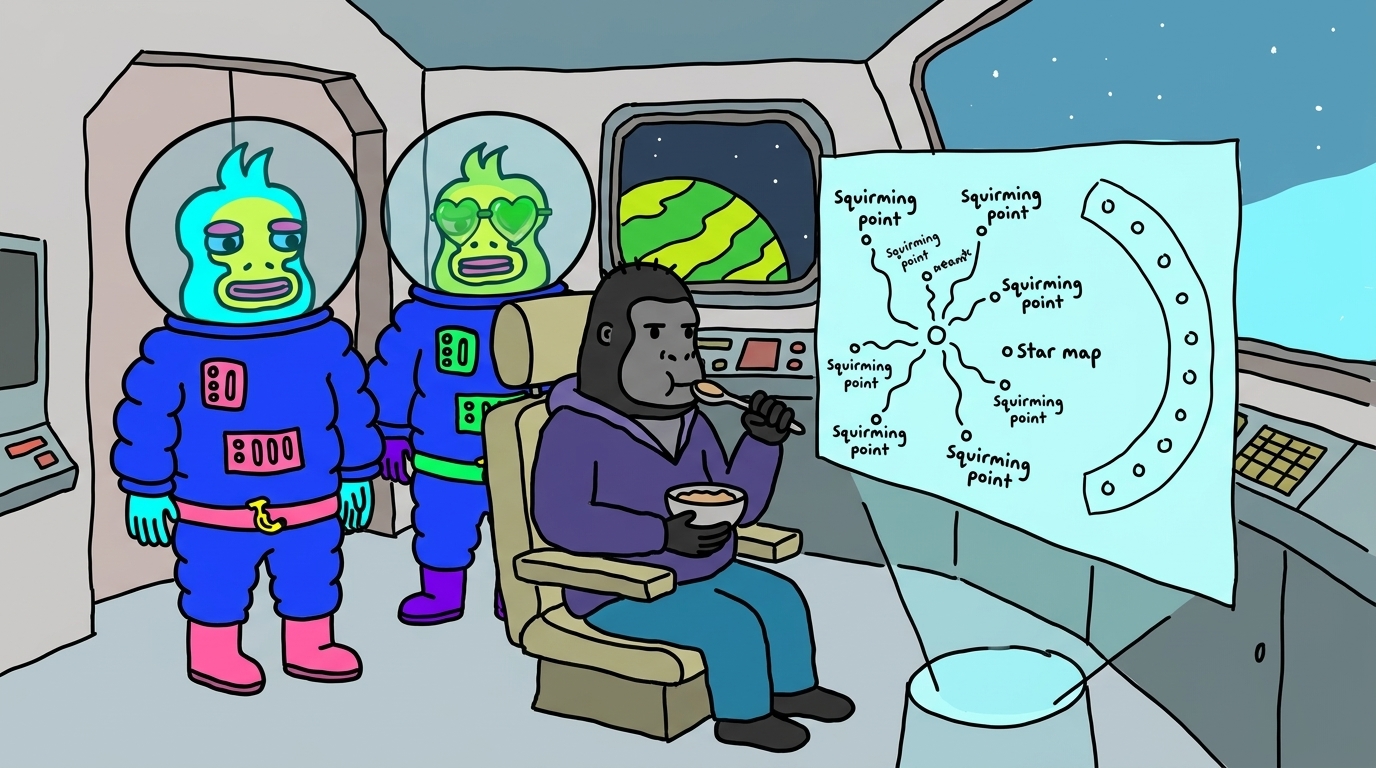
Interior of a small cockpit. The grey ape in the purple hoodie sits eating from a bowl, watching a slowly turning pale blue holographic star map. The other two stand behind him. The crew: a grey ape in a purple hooded sweatshirt and blue trousers; a crew member with a green-and-cyan face, a teal flame of hair, in a puffy electric blue spacesuit with pink rectangular patches, cyan gloves and pink boots, inside a clear round fishbowl helmet; and a crew member with a bright green face and green hea
The Pepe Voyager, low orbit

The Third of the Map

The map had been sitting in the cockpit for six weeks, turning slowly, being patient about it.

Hodl had taken to eating breakfast in front of it. This was not, he maintained, obsession. It was simply where the good chair was.

"You're doing it again," said Teebs.

"I'm eating."

"You're eating *at the map*."

The last third was different. The first two-thirds had been little points with squirming labels, and they had gone to them, and the labels had turned out to mean things like *chicken* and *hiccups*. But the final stretch curved away from everything, out past the edge of anywhere the snack bar had a word for, and the points there were not labelled at all. They were just there. Waiting. Slightly smug about it.

Degen came in with the confidence of a man who had rehearsed.

"So I've been thinking—"

"No," said Hodl.

"You don't know what I was going to say."

"You were going to say we should go."

Degen paused. "Okay, but *hear the way I was going to say it*."

The thing was, Hodl had already decided. He had decided somewhere around week two, in front of the map, with a spoon in his hand, and he had spent the four weeks since being annoyed about how obvious it was going to look.

He put the bowl down.

"Teebs. How's the ship."

"Held together." She considered. "Emotionally as well."

"Degen. How's the fuel."

"Some!"

"Right." Hodl stood up, and the map turned, and the ten unlabelled points went round with it like they'd been expecting this. "Get the grain out of the hold. We're going to need the space."

Degen was already running.

"AND THE SANDWICH THING," he shouted from the corridor. "I HAVE AN IDEA ABOUT SANDWICHES—"

"We'll discuss the sandwich," Hodl called back, and did not know, at that moment, how much of the next four months this sentence was going to define.

The Planet That Was Embarrassed
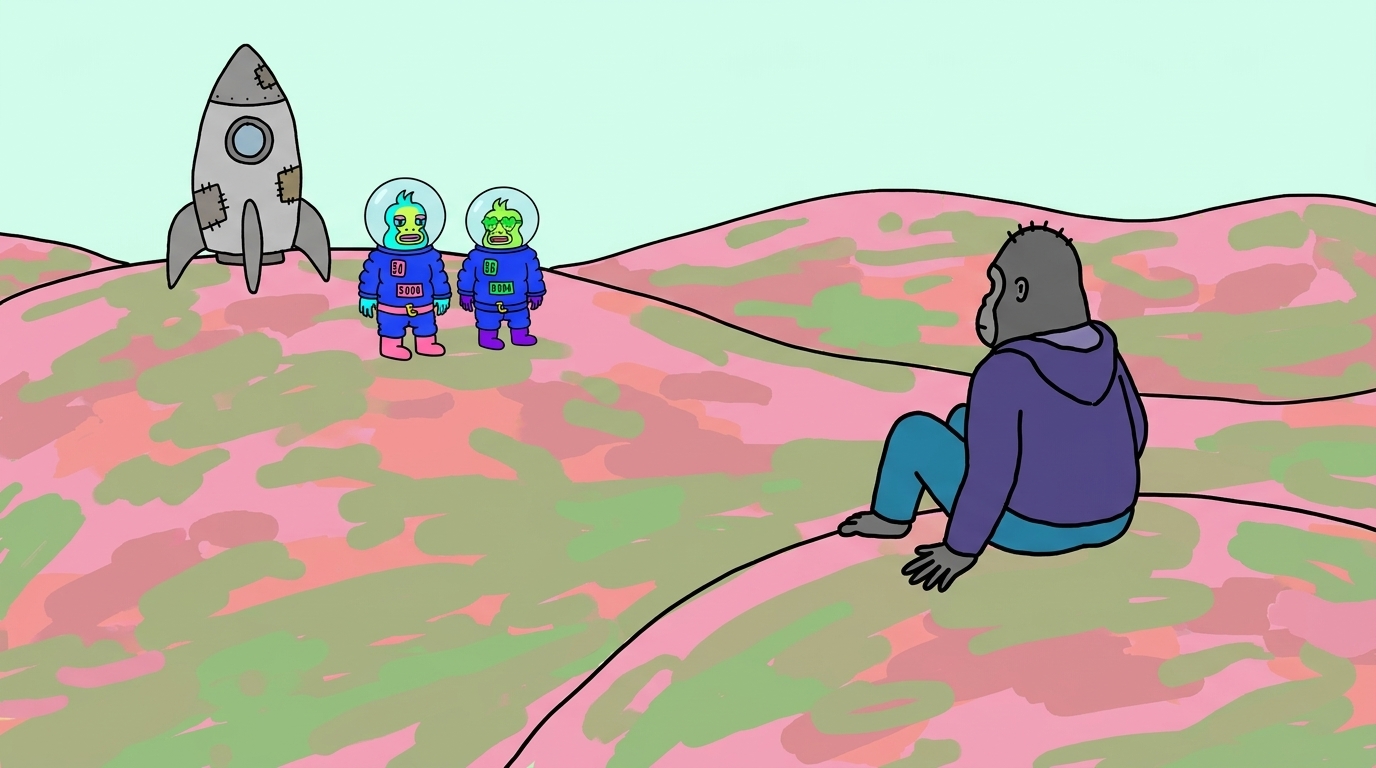
Exterior on soft rolling hills of a pink and green planet. The grey ape in the purple hoodie sits alone on a low round hill with one hand resting on it. The other two watch from a distance beside a patched grey rocket. The crew: a grey ape in a purple hooded sweatshirt and blue trousers; a crew member with a green-and-cyan face, a teal flame of hair, in a puffy electric blue spacesuit with pink rectangular patches, cyan gloves and pink boots, inside a clear round fishbowl helmet; and a crew memb
Threx, a small blue planet

The Planet That Was Embarrassed

The first unlabelled point was a small blue planet, and the small blue planet was mortified.

They knew this within ninety seconds of arrival, because it told them. Not in words. In *weather*. A hot pink flush came up over the entire northern hemisphere as the Voyager came into view, rolled across the equator, and settled into a sort of blotchy magenta that Teebs described, with great tenderness, as "the exact colour of wanting to be somewhere else."

"Is it sick?" said Degen.

"It's embarrassed."

"Planets don't get embarrassed."

"This one's *bright pink*, Degen."

They landed carefully, which is to say Degen landed and the others held on. Up close the surface was covered in enormous soft rolling hills, and every hill, on closer inspection, was a place where the planet had tried to make a mountain and given up partway.

It took most of a day to work out the story, and it was this. Threx had been forming for four billion years. Threx had been *trying*. Other planets in the region had managed rings, moons, weather systems, a really respectable volcano. Threx had managed hills. Threx was aware that it had managed hills. Threx had been carrying this quietly, alone, for longer than anyone in the crew could count.

Hodl walked out about a mile from the ship and sat down on one of the failed mountains and looked at it for a while.

"It's nice," he said. Out loud. To a planet.

The hemisphere went a slightly deeper pink.

"No, I mean it. It's *soft*. Do you know how much of space isn't soft? We spent eleven hours a day going backwards past a black hole. There is a *chicken*." He patted the hill. "You're comfortable. That's a whole thing. That's a real thing to be."

Behind him, at a respectful distance, Degen was mouthing *is he talking to the ground* and Teebs was holding up one hand to mean *leave it*.

By evening the pink had faded to a calm, unbothered green.

They stayed two extra days. Nobody suggested it. Nobody needed to.

Customs at the Edge of Nowhere
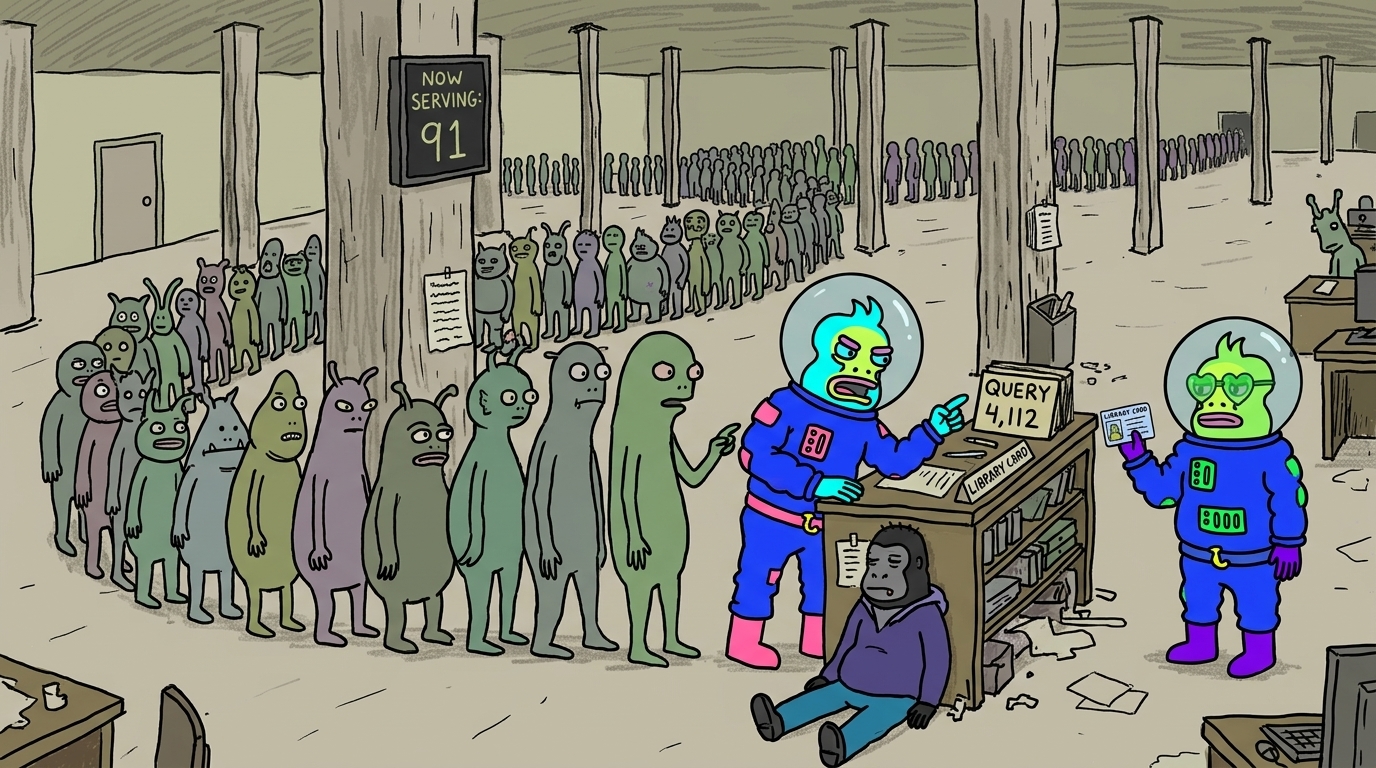
Interior of a vast dingy bureaucratic hall with an enormous queue of aliens snaking around pillars. The grey ape sits on the floor exhausted, the teal-haired crew member argues at a tall desk, the green one holds up a small card. The crew: a grey ape in a purple hooded sweatshirt and blue trousers; a crew member with a green-and-cyan face, a teal flame of hair, in a puffy electric blue spacesuit with pink rectangular patches, cyan gloves and pink boots, inside a clear round fishbowl helmet; and
Waystation Nine, arrivals hall

Customs at the Edge of Nowhere

Waystation Nine sat exactly nowhere, served no destination, and had a customs hall.

"Why," said Hodl.

The queue answered him. It went out of the arrivals door, around a support pillar, twice, and terminated at a desk behind which sat a creature made largely of paperwork and mild disappointment.

Their number was 4,112. The board said 91.

"Right," said Degen, cracking his knuckles inside his gloves. "I'll handle this."

What followed was six hours that the crew would later refer to only as *the incident*, and which is recorded in the Waystation Nine logs as *Query 4,112 (ongoing)*. Degen argued that they were not importing anything. The officer explained that the ship itself was an import. Degen argued that the ship was leaving. The officer explained that a departing import is an export, and that exports required the form he had just given them, which was the form for imports, because Waystation Nine had run out of the other one in the year 200,340.

At hour four, Degen tried bribery. The officer accepted, thanked him warmly, and moved them from 4,112 to 4,109.

At hour five, Hodl sat down on the floor.

At hour six, Teebs — who had said nothing for a very long time, and who had wandered off around hour two, and who nobody had thought to look for — came back holding a small laminated card.

"I got a library membership," she said.

"You got a *what*."

"There's a desk. Round the back. Nobody's at it." She turned the card over. "It says holders of a Waystation Nine reader's card are considered residents for the purposes of customs."

The hall went quiet in a radius of about four metres.

The officer read the card twice. Something behind all the paperwork made a long, slow, creaking noise that might have been respect.

"Residents," he said, "may use the side door."

The side door was nine feet away and had been there the entire time.

The Library That Ate Its Librarian
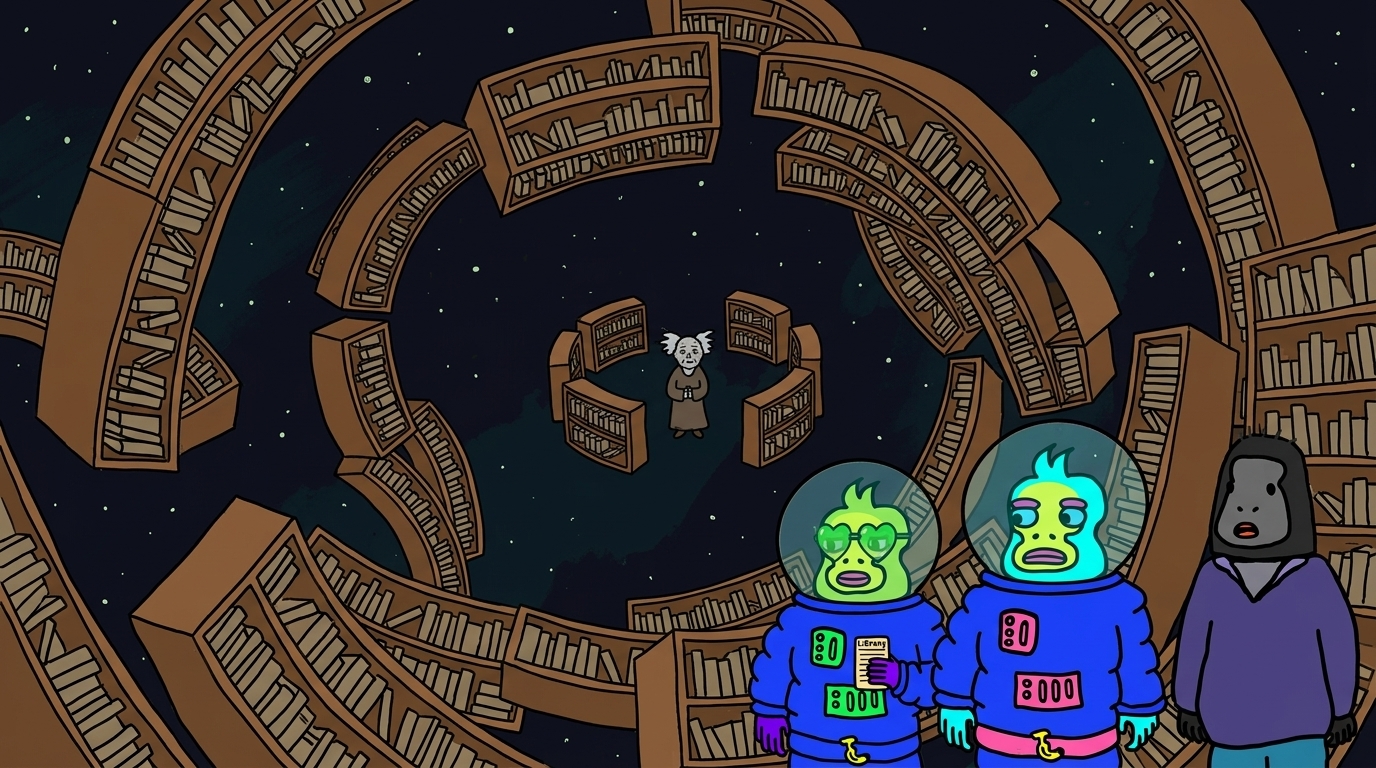
Interior of an endless library floating in open space with no walls, shelves stretching in every direction and tumbling slowly. In the centre a small, very old, perfectly still figure. The three crew look up at it. The crew: a grey ape in a purple hooded sweatshirt and blue trousers; a crew member with a green-and-cyan face, a teal flame of hair, in a puffy electric blue spacesuit with pink rectangular patches, cyan gloves and pink boots, inside a clear round fishbowl helmet; and a crew member w
The Drifting Stacks

The Library That Ate Its Librarian

Teebs's library card, it turned out, worked.

It worked four days later and two hundred light years away, at a place the map marked with a point and no label, which resolved on approach into a slowly tumbling structure the size of a small country, made entirely of shelves.

The Drifting Stacks had no walls. Just shelving, going out in every direction, turning gently, with the books held on by a politeness that Hodl chose not to examine too closely.

"Reader's card," said the door, and Teebs held it up, and the door said "lovely" and let them in.

The trouble started in Astronomy.

Specifically, it started when Degen — who had been told twice — pulled a book out without noting where it went, and the shelf, deprived of its reference, quietly forgot where it was. It drifted. It bumped its neighbour. Its neighbour forgot too.

"Degen."

"I'm putting it back!"

"Which one is it."

Degen looked at the eleven thousand identical shelves now slowly rotating around them, and his face did something complicated.

The Stacks, they learned over the following hours, had once had a librarian. The librarian had known where everything went. The librarian had known this so thoroughly, and for so long, that when the shelves began to drift the librarian had simply — stepped in. Taken a position. Become the reference point.

They found her in the middle: a small, calm, extremely old shape of a person, holding perfectly still, with about nine hundred years of shelving arranged in careful orbit around her.

"Sorry," said Degen, in a very small voice.

She did not move. She did not need to. But one shelf, four rows over, slid quietly back into place, and then another, and then the whole vast tumbling country of books drew itself in around her like a held breath.

On the way out, Teebs put her library card on the shelf by the door.

"She might want it back one day," she said.

Nobody argued.

Degen Buys a Moon
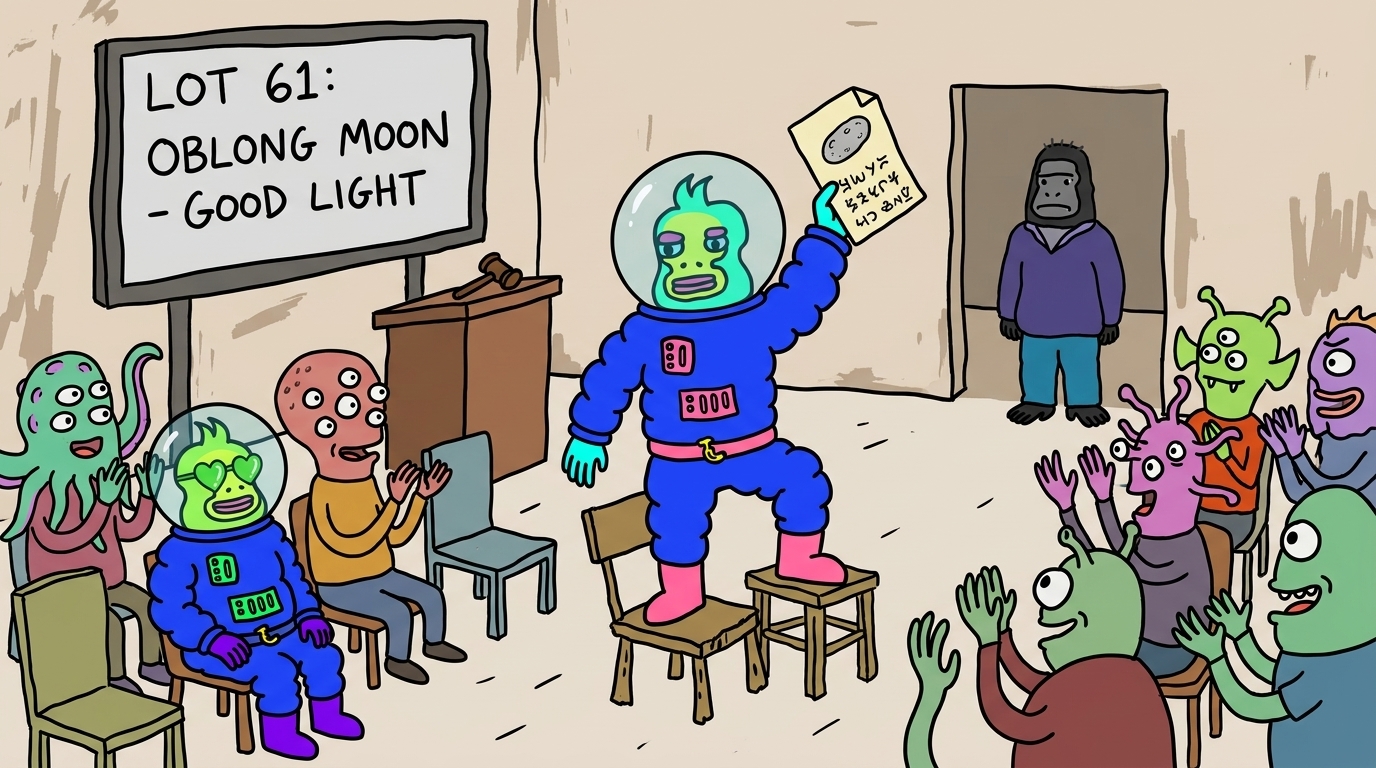
Interior of a crowded alien auction house. The teal-haired crew member stands on a chair holding up a document, surrounded by applauding aliens. The grey ape in the purple hoodie stands in the doorway looking horrified. The crew: a grey ape in a purple hooded sweatshirt and blue trousers; a crew member with a green-and-cyan face, a teal flame of hair, in a puffy electric blue spacesuit with pink rectangular patches, cyan gloves and pink boots, inside a clear round fishbowl helmet; and a crew mem
The Rimward Auction Barge

Degen Buys a Moon

Nobody was supposed to be bidding.

They had gone to the Rimward Auction Barge for fuel, which the barge sold, at the back, past the auction floor. This routing decision was made by the barge and, in hindsight, was not an accident.

Hodl said, at the door, with total clarity: "We are not buying anything."

"Obviously," said Degen.

"Say it."

"We are not buying anything."

"Teebs."

"We're not buying anything," said Teebs, who was already looking at a rack of secondhand sunglasses.

Lot 61 came up at hour two. It was a moon. Not a large moon. A modest, tidy, slightly oblong moon with, the catalogue noted, *good light*. The bidding opened at an amount that Degen described as "frankly insulting to the moon," and here is the part that matters:

Degen did not raise his hand.

Degen raised his hand to *point at how low the bidding was*, which the auctioneer — a professional, working at speed, in a room designed for exactly this — read as a bid, and the room read as a bid, and Degen, finding forty species suddenly looking at him with approval, discovered that he did not have it in him to explain.

So he bid again.

Hodl got back from the fuel counter eleven minutes later to find his pilot standing on a chair, being applauded, holding a deed.

"What did you do."

"I got us a *moon*."

"WITH WHAT MONEY."

Degen's face, for the first time in the entire voyage, went briefly blank.

The moon, as it turned out, cost the grain. All of it — every scrap they had brought up off Moon 7, plus the cargo netting, plus a bowl.

They argued about it for a week. It ended, as these things do, when Teebs pointed out that the moon had good light, and that they had nowhere to put a moon, and that this made it the most impractical and therefore most genuinely theirs thing any of them had ever owned.

It is still there. It is still oblong. The deed is taped to the cockpit ceiling.

The Very Long Sandwich
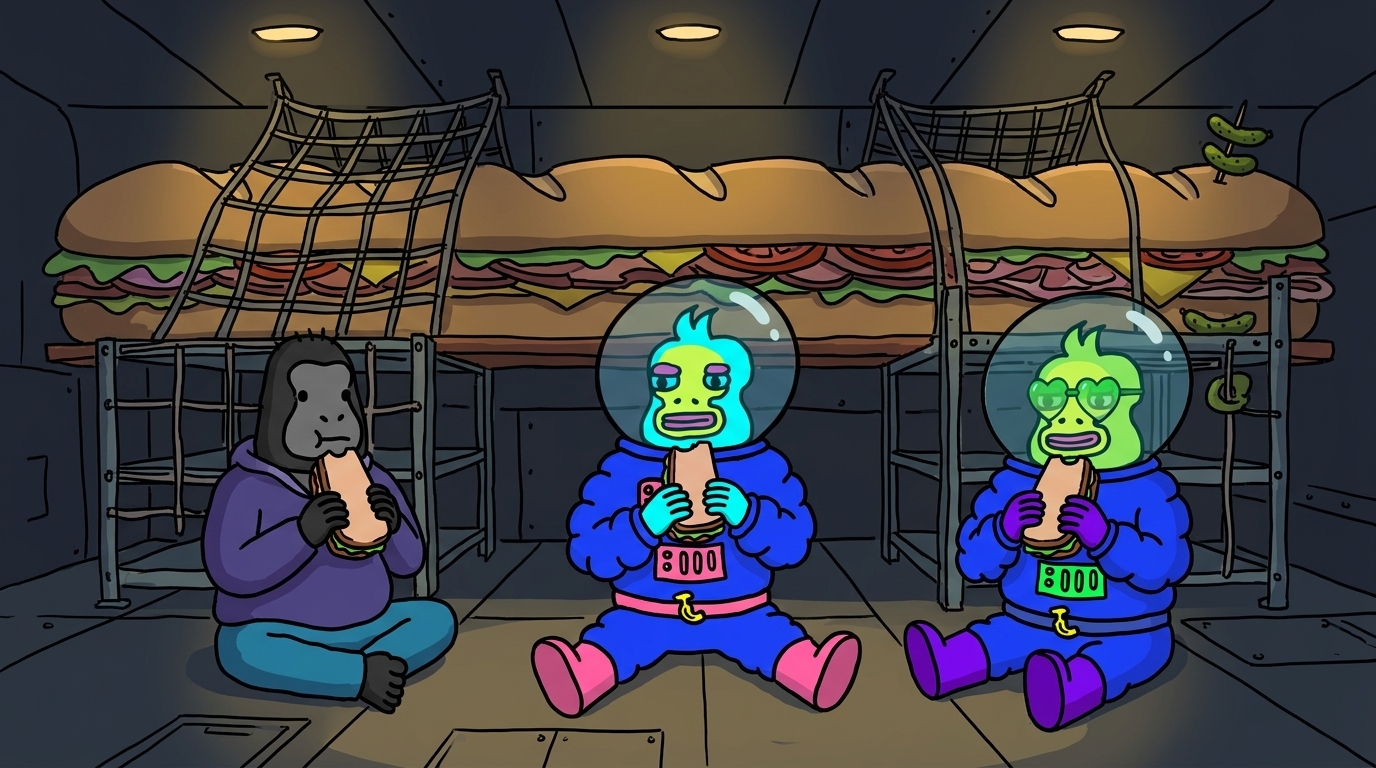
Interior of a cargo bay at night with low lights. One enormous sandwich runs the entire length of the room on a rig of cargo netting and shelving. The three crew sit on the floor eating slices of it. The crew: a grey ape in a purple hooded sweatshirt and blue trousers; a crew member with a green-and-cyan face, a teal flame of hair, in a puffy electric blue spacesuit with pink rectangular patches, cyan gloves and pink boots, inside a clear round fishbowl helmet; and a crew member with a bright gr
Deep space, between markers

The Very Long Sandwich

The sandwich was Degen's idea, and it was, in fairness, a good one.

The stretch between the sixth and seventh markers was four months of absolutely nothing. No planets. No stations. No embarrassed geology. Just distance, being distance, at length.

"We should make a sandwich," said Degen, on day three.

"We have sandwiches."

"A *long* one. One sandwich. The whole way. We add to it."

Hodl opened his mouth to say no and then didn't, because four months is a long time and a man has to have something.

It began at the galley counter and went aft. By week two it had reached the corridor. By week six they had taken out a bulkhead panel — Teebs's decision, made quietly, announced to nobody — and by week eleven the sandwich passed through the cargo bay on a rig of cargo netting and one repurposed shelf, and had developed regions.

There was the Early Section, which was mostly cheese and optimism. There was the Grain Quarter, where they had used the last of what the moon had cost them, and which everybody agreed had a solemn quality. There was a stretch around week nine that Degen had built alone during a bad patch and which nobody was allowed to ask about. There was the part where Teebs had begun putting one small pickled thing at every marker point they passed, so that the sandwich became, gradually and without anyone deciding it, a map.

On the last night before the seventh marker they cut it.

They cut it at the Grain Quarter, because that seemed right, and they sat in the cargo bay with the lights down and ate a section each, and Hodl said it was the worst thing he had ever eaten and asked for more, and Degen cried a little bit and blamed the pickles.

They kept the far end. It is in the freezer. It is going home.

A Small Problem With Mirrors
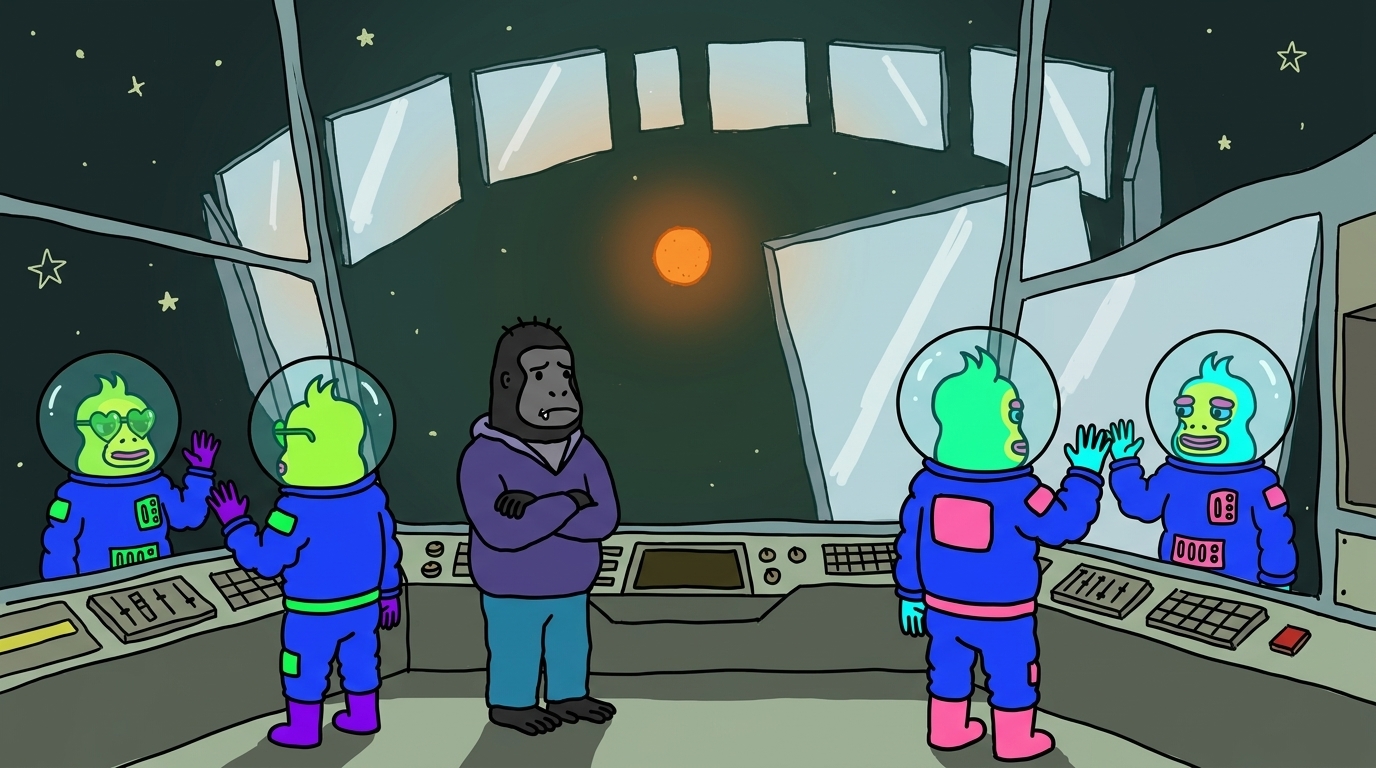
Interior of a cockpit looking out at enormous flat mirror panels hanging in space around a dim orange star. The grey ape stands at the window with arms folded; the other two wave at their own reflections in the mirrors. The crew: a grey ape in a purple hooded sweatshirt and blue trousers; a crew member with a green-and-cyan face, a teal flame of hair, in a puffy electric blue spacesuit with pink rectangular patches, cyan gloves and pink boots, inside a clear round fishbowl helmet; and a crew mem
The Reflected Belt

A Small Problem With Mirrors

The seventh marker was a belt of mirrors, and the mirrors had opinions.

They were not mirrors exactly. They were flat, and they were the size of continents, and they hung in a slow ring around a star that had nothing else left, and when the Voyager passed the first one the crew saw themselves — correctly, in every detail, four seconds before they did anything.

"That's me," said Degen.

"Yes."

"That's me *waving*."

"You're not waving."

Degen waved. Four seconds late.

They spent an unwise amount of the following day trying to catch it out. Teebs stood absolutely still for eleven minutes; her reflection stood absolutely still and then, at the end, scratched its ear, and eleven minutes and four seconds after she started, so did she, and she said "oh" in a very small voice and sat down.

Hodl refused to look. This lasted two hours.

When he did look, the mirror showed him at the cockpit window with his arms folded, not looking. Which he had been. Four seconds ago.

"It's not the future," he said slowly. "It's just — very good at us."

The unnerving part was not the reflections. The unnerving part was how quickly all three of them stopped finding it unnerving, and how by evening they were doing bits: Degen conducting an orchestra of himself, Teebs and her reflection attempting a handshake that could not by any physical law occur, Hodl — after some persuasion, and only once — waving.

They left the belt at speed the next morning.

Nobody said why. But all three of them had, at some point in the night, gone back to the window alone, and stood there, and watched the small delayed version of themselves that was still, four seconds behind, having a slightly better time than they were.

The Committee of Weather
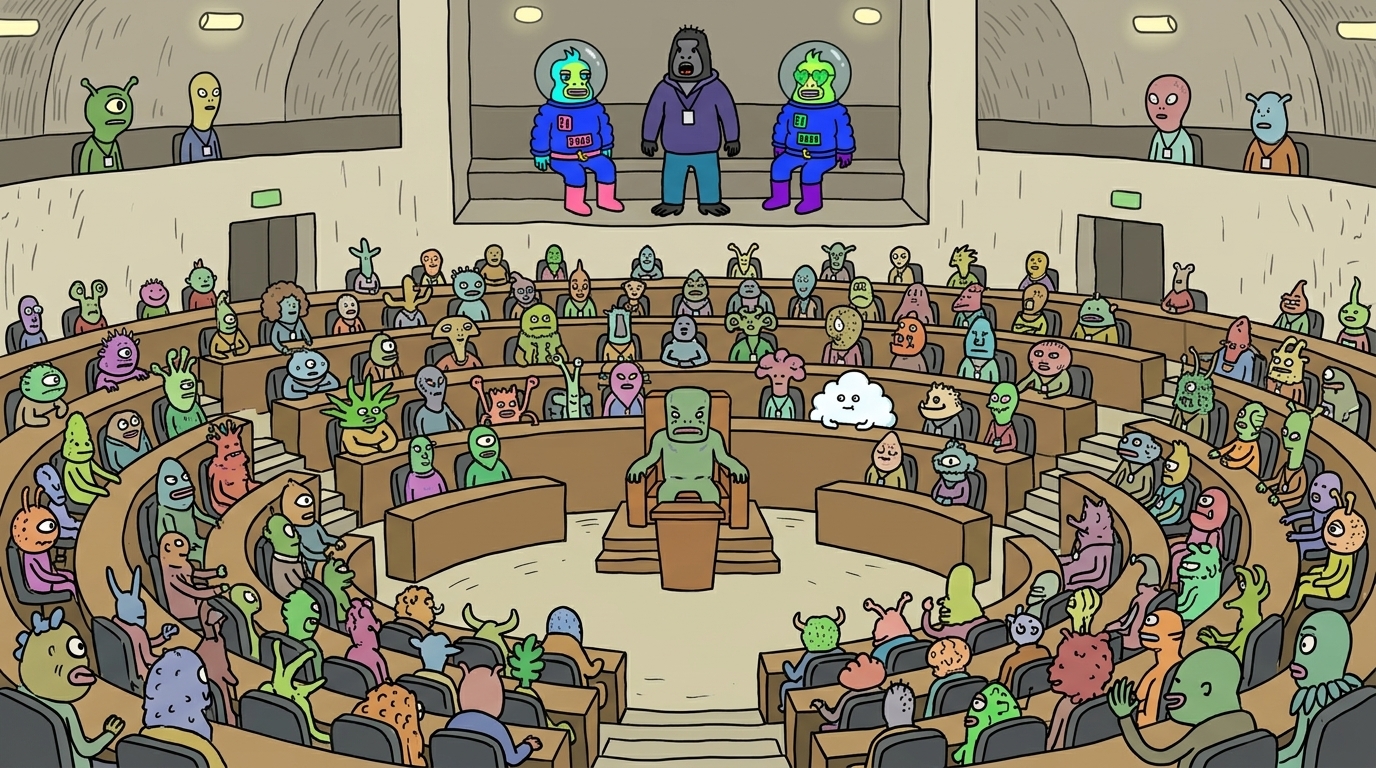
Interior of an enormous circular parliament chamber packed with strange alien delegates, one of which is a small cloud. In the raised public gallery the grey ape in the purple hoodie stands up mid-speech, the other two seated beside him. The crew: a grey ape in a purple hooded sweatshirt and blue trousers; a crew member with a green-and-cyan face, a teal flame of hair, in a puffy electric blue spacesuit with pink rectangular patches, cyan gloves and pink boots, inside a clear round fishbowl helm
Barometric Station Gamma

The Committee of Weather

Barometric Station Gamma controlled the weather for one hundred and six worlds and had not agreed on anything since the year 12,000.

The crew arrived during an extraordinary session. They were made observers, given a lanyard each, and seated in the public gallery, from which they watched the following happen over nine hours:

A motion was raised to give the planet Threx a light seasonal rain.

The motion was seconded.

The delegate for Precipitation objected on the grounds that Threx had not filed. The delegate for Small Bodies objected to the objection on the grounds that Threx had no hands. The chair ruled that having no hands was not an exemption, cited a precedent from the year 40,900 involving a gas giant, and was immediately challenged by four delegates at once, one of whom was a cloud.

At hour six a sub-committee was formed.

At hour eight the sub-committee reported that it required a sub-committee.

At hour nine, Hodl stood up in the public gallery, which observers are not permitted to do, and said: "It's shy."

The hall stopped.

"It's not that it didn't file. It's that it's been sitting out there for four billion years thinking everyone else got the good stuff and it got hills, and it is *not going to ask you* for rain, because asking would mean saying out loud that it wants something." He was aware, distantly, that he was shouting at a parliament. "So file it for it. It's four minutes of your time and it's the entire rest of its life."

There was a very long silence.

The cloud raised the motion. It passed unanimously, which had not happened since 12,000, and the minutes record the reason for the vote as *observer testimony*.

It rains on Threx now. Lightly. Every eleven days.

Teebs says the hills are getting greener. Hodl says he hasn't checked.

Hodl checks.

Teebs and the Quiet Star
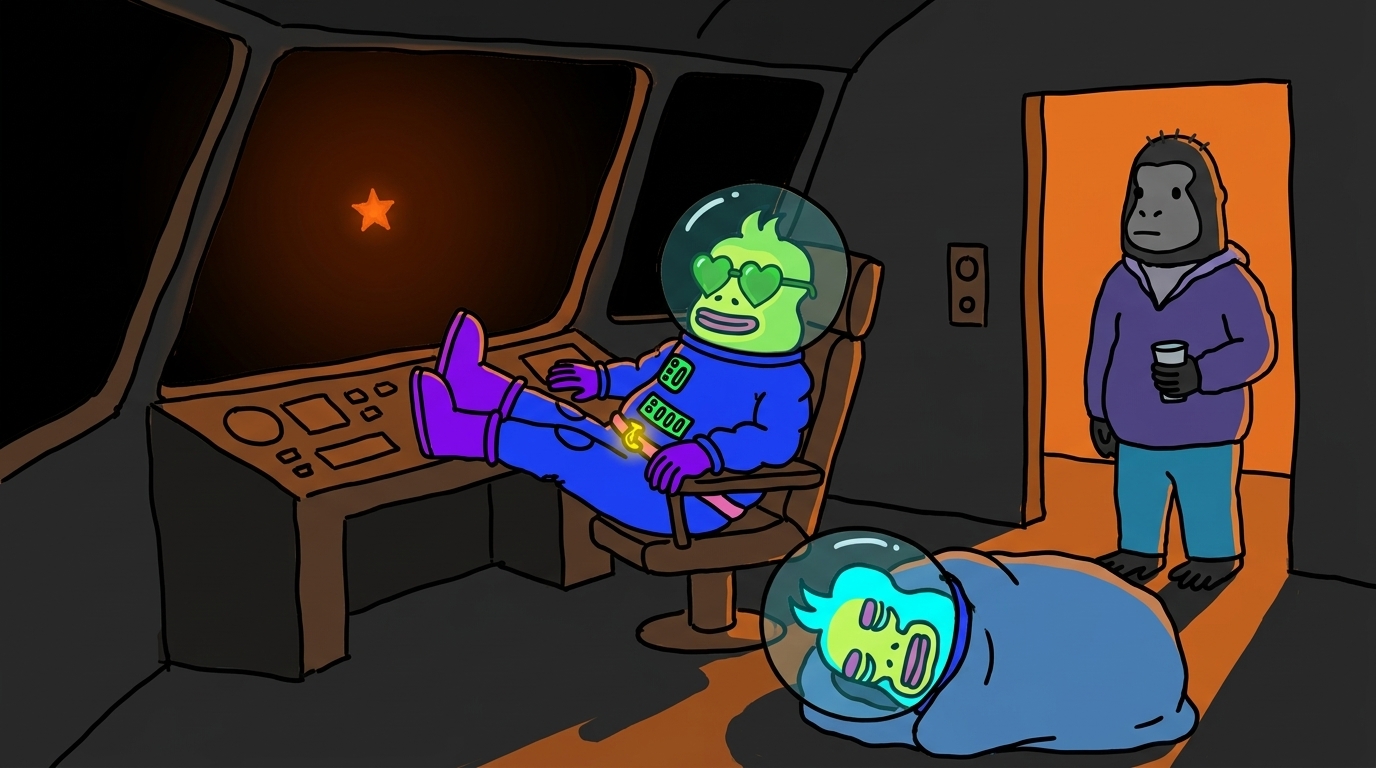
Interior of a darkened cockpit at night lit only by a small deep orange star through the window. The green crew member with heart sunglasses sits with boots up on the console, the grey ape stands in the doorway holding a cup, the teal-haired one sits on the floor wrapped in a blanket. The crew: a grey ape in a purple hooded sweatshirt and blue trousers; a crew member with a green-and-cyan face, a teal flame of hair, in a puffy electric blue spacesuit with pink rectangular patches, cyan gloves an
An unnamed star, close orbit

Teebs and the Quiet Star

The ninth marker was a star with nothing around it, and Teebs took the night watch alone.

This was not unusual. What was unusual was that she did not put the radio on.

The star was small and old and a deep steady orange, and it made no noise, and it had no planets, and it had presumably been doing this for a very long time before anybody arrived to notice and would go on doing it for a very long time after. Teebs sat with her boots up on the console and her chin in her hands and watched it.

Around hour three, Hodl came up for water and found her there and stopped in the doorway.

"You all right?"

"Mm."

He got the water. He did not leave.

"It's the only thing out here," she said eventually. "For — really a long way. It's just it."

"Yeah."

"Doesn't seem to mind."

Hodl thought about this for a while, standing in the doorway of his own cockpit, holding a cup.

"Are you all right?" he said again, differently.

And Teebs said, "I keep thinking about the librarian."

So they talked about the librarian. For two hours, with the lights off and the small orange star not going anywhere. About standing still so the shelves know where they are. About whether that was the saddest thing either of them had ever seen or the least sad. About how she had held perfectly still for nine hundred years and how the books had all come home.

At some point Degen appeared in the doorway in a blanket, said nothing at all, which had never once happened, and sat down on the floor.

The three of them watched the star until the watch ended.

It is not marked on any chart as anything. Teebs marked it. She called it *Quiet*. That is now, officially, in the log, the name of a star.

The Last Marked Point
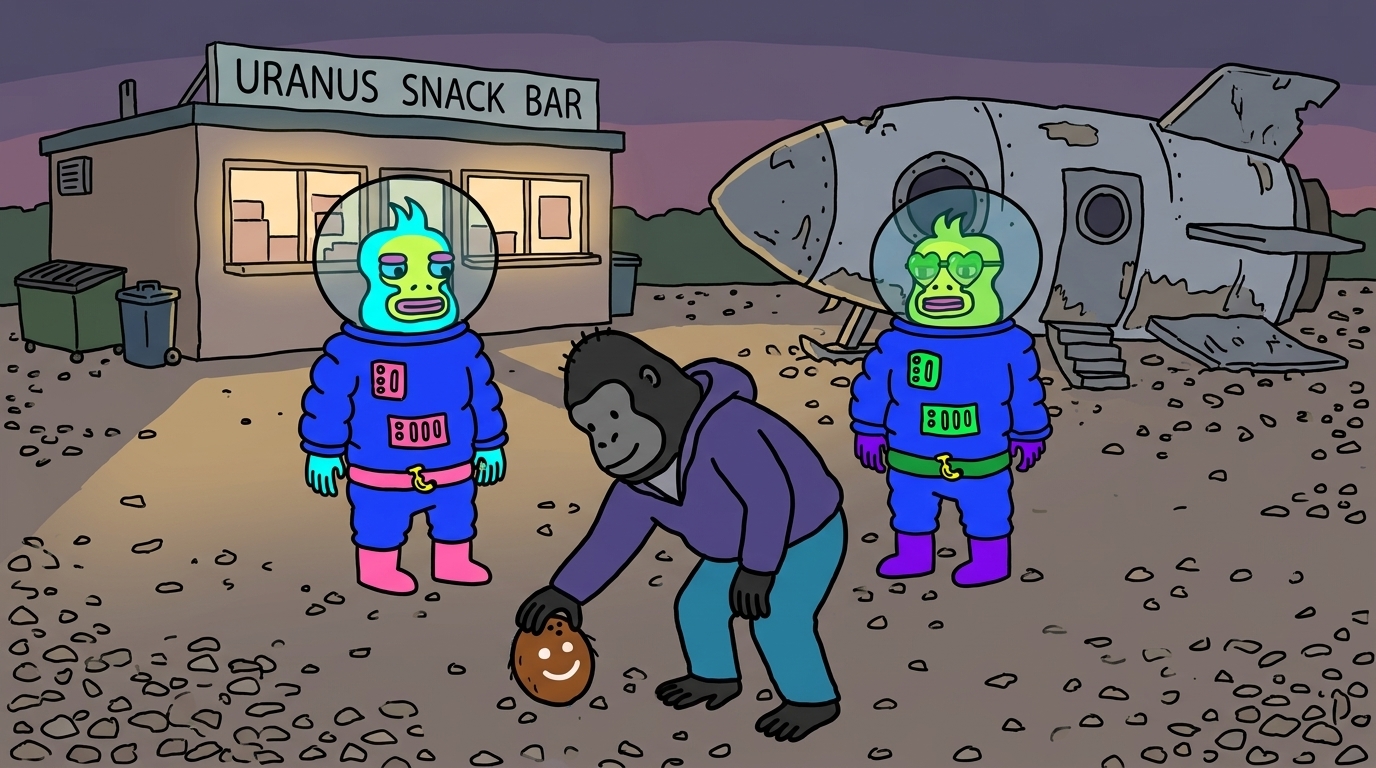
Exterior at dusk on a gravel car park behind a small lit snack bar. The grey ape in the purple hoodie bends down to pick up a coconut with a small painted smiling face on it. The other two stand nearby, a battered grey rocket landed behind them. The crew: a grey ape in a purple hooded sweatshirt and blue trousers; a crew member with a green-and-cyan face, a teal flame of hair, in a puffy electric blue spacesuit with pink rectangular patches, cyan gloves and pink boots, inside a clear round fishb
The end of the map

The Last Marked Point

The last marked point was four minutes from the snack bar.

They worked this out about a day before arrival, when the navigation finally resolved, and there was a period of roughly forty seconds in which nobody said anything at all.

"That's the car park," said Degen.

It was the car park.

The map — the great turning map, four billion points of light, ninety thousand light years of curve, dispensed by a vending machine in exchange for a coin and a bag of moon-chips it had no intention of releasing — ended at the gravel strip behind the Uranus snack bar, eleven metres from the bins.

They landed. They walked over. The last marked point was a spot on the gravel, unremarkable in every way, next to a drain.

Hodl stood on it.

Nothing happened.

"Is something meant to happen?"

Something was. It happened four minutes later, when the back door of the snack bar banged open and a delivery of coconuts came out on a trolley, and the trolley hit the drain, and one coconut — a single coconut, with a small painted face on it, of the kind sold near the till for reasons nobody has ever established — bounced off the gravel, rolled eleven metres, and stopped against Hodl's boot.

They looked at it.

"Four billion years of stars," said Teebs.

"Mm," said Hodl.

"To be here for the coconut."

He picked it up.

Inside, the machine was still broken. The moon hamster was awake and had opinions about the hour. The far end of the sandwich came out of the freezer and was, by unanimous agreement, worse than remembered and eaten anyway.

And on the wall behind the soda fountain, where a map had once unfolded out of a coin slot into a diagram of everywhere, Degen taped up a deed to a small oblong moon with good light, and a coconut with a face on it, and a note in Teebs's handwriting that read: **QUIET — a star, ours, unremarkable, still there.**

The Uranus Exploration Club meets Tuesdays.

Everyone is welcome. Bring a coin.